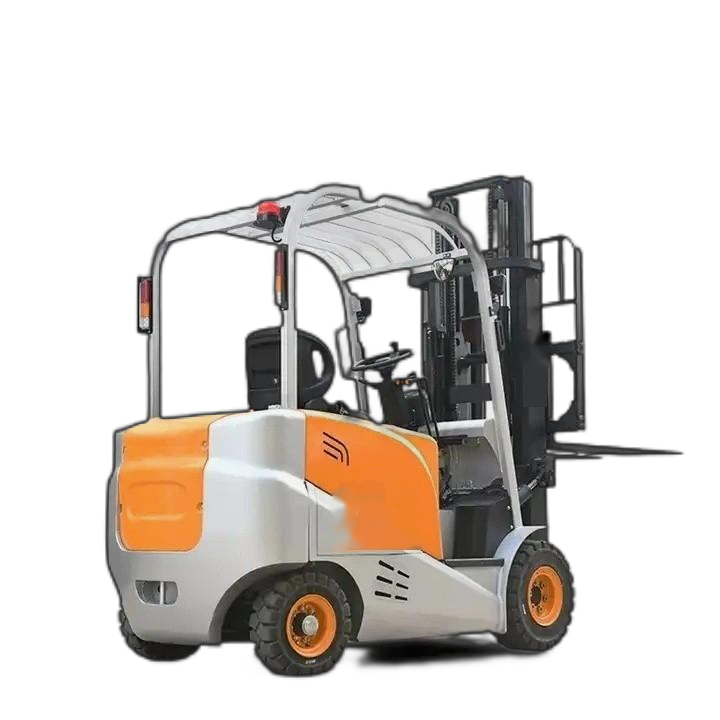

An electric forklift electronic control system consists of five core components: Vehicle Control Unit (VCU), Motor Control Unit (MCU), Battery Management System (BMS), electro-hydraulic control unit and on-board connectivity terminal. Driven by three major catalysts — widespread lithium battery adoption, large-scale deployment of unmanned warehousing, and accelerated domestic substitution — domestic technology is evolving from discrete low-voltage analog control along four major development lines: highly integrated high-voltage silicon carbide (SiC) architectures, full-domain intelligent coordination, software-defined vehicles, and fully independent secure control, forming a clear and implementable medium- and long-term technical roadmap.
Overall Architecture of Electric Forklift Electronic Control Systems
I. Hardware Architecture: From Discrete Multiple Controllers to Highly Integrated All-in-One Designs
- Tri-in-one integrated controllers for traction, lifting and steering become mainstreamTraditional forklifts adopt separate traction, pump and steering controllers, resulting in excessive wiring harnesses and high failure rates. New-generation integrated powertrain domain controllers integrate traction, hydraulic lifting and electric steering drives into a single unit, with one master MCU coordinating multi-motor synchronous control.
- Warehouse compact trucks (24/48 V): The penetration rate of integrated controllers will exceed 60% by 2026;
- 3.5–10 ton counterbalance forklifts: The penetration rate of integrated electro-hydraulic power units (EPU) has surpassed 42%. Independent hydraulic valve controls are eliminated, with on-demand flow regulation cutting overall energy consumption by 18.7%;
- Dedicated all-in-one controllers for unmanned forklifts (Kinco, Inovance, Jiachen Intelligent) come standard with dual open/closed-loop modes, delivering smooth manual operation and precise positioning for automatic navigation.
- Comprehensive shift to high-voltage platforms: 400 V platforms gain popularity while 800 V enters heavy-duty demonstration stages
- Legacy low-end models: 48 V/80 V low-voltage lead-acid and lithium batteries are being phased out;
- Current mainstream: 320–384 V high-voltage lithium battery platforms with system overall efficiency above 92%, supporting 1–2 C fast charging and extending single-shift operation duration by 18%;
- Future heavy-duty direction: 800 V high-voltage platforms will be deployed on 6–16 ton heavy forklifts and high-frequency continuous-operation scenarios, featuring smaller charging currents, lightweight wiring harnesses and a 30% boost in power density. Matching electronic controls are upgraded with high-voltage SiC power modules to replace conventional IGBTs.
- Power devices: SiC gradually replaces silicon-based IGBTs with tiered deployment across product segments
- Mid-to-high-end lithium forklifts and high-voltage heavy-duty models are mass-equipped with SiC MOSFETs, cutting switching losses by 30%, sustaining operating temperatures up to 175°C, shrinking heat dissipation volume by 40%, and reducing energy consumption by 12% per hundred ton-kilometers;
- Cost-effective warehouse trucks retain silicon-based Intelligent Power Modules (IPMs), with cost control realized via parallel MOSFETs and optimized drive algorithms;
- The proportion of domestic power semiconductors (StarSem, Silan Micro, CR Micro) supporting electronic control systems keeps rising, breaking the monopoly of overseas suppliers including Infineon and onsemi.
- Miniaturized hardware and standardized liquid cooling heat dissipationElectronic controls are upgraded from air cooling to integrated liquid cooling heat dissipation. For high-voltage fast-charging scenarios, cell temperature differences are controlled within 5°C. Complete vehicles adopt dual power supply redundancy and wide voltage compatibility design with an IP65 minimum protection rating, adapting to harsh operating environments including outdoor yards, cold storage and dusty workshops.
II. Battery Management System (BMS): From Passive Protection to Full-Domain Intelligent Energy Regulation
With lithium battery penetration exceeding 82%, BMS has become a core subdomain of electronic control systems, evolving along four key technological directions:- High-precision SOC/SOH estimationKalman filtering combined with AI self-learning algorithms limits SOC estimation error to ≤±3%, solving long-standing pain points such as erratic power readings and sudden vehicle shutdown mid-operation. Bidirectional active balancing reduces battery capacity degradation over the full lifecycle by 15%.
- Closed-loop thermo-electric coupling controlBMS communicates in real time with vehicle VCU and liquid cooling systems to dynamically allocate cooling power under fast charging, hill climbing and heavy-load conditions. Thermal runaway warning response reaches microsecond level, slashing overheating shutdown failures by 90%.
- Multi-energy compatible managementA single BMS supports lithium iron phosphate batteries, sodium-ion batteries and auxiliary energy storage from hydrogen fuel cells simultaneously. It enables intelligent switching among battery swapping, opportunity charging and slow charging modes, with automatic matching of charging power curves.
- Deep integration of BMS and VCUIntegrated domain controllers eliminate standalone BMS hardware. Battery status data is directly transmitted via the vehicle CAN FD bus, reducing signal conversion losses and lifting energy recovery efficiency to 23.4%.
III. Control Algorithms & Software: Standardized FOC, Software-Defined Vehicles, Full-Scope OTA Updates
- Motor control: Universal adoption of FOC vector control, with Model Predictive Control (MPC) introduced for high-end modelsCrude V/F square-wave control is phased out on entry-level vehicles, and 180° sine-wave Field-Oriented Control (FOC) becomes standard. It eliminates jerk during startup, lifting and braking, optimizes ride smoothness metric (Jerk value) by 40%, and limits no-load noise to ≤58 dB.Heavy-duty and unmanned forklifts deploy MPC, which pre-emptively predicts loads, slopes and steering conditions to dynamically adjust torque output, preventing rollback on ramps and stabilizing lifting under heavy loads.
- Intelligent energy-saving electro-hydraulic coordination algorithmsConventional fixed-displacement pumps with continuous overflow are eliminated. The electronic control unit collects real-time data on fork height, load weight and pressure demand to dynamically adjust pump motor speed, maintaining low-speed standby under no-load conditions and cutting hydraulic energy consumption by over 20%.
- Software-defined architecture + remote OTA iterationElectronic control firmware adopts domestic dual-core RISC-V/ARM Real-Time Operating Systems (RTOS). Vehicle control logic, power curves and safety strategies are all software-configurable. Remote OTA upgrades are supported for the entire vehicle, BMS and motor controllers, shifting offline calibration to one-click cloud-based adaptation for diverse scenarios (warehousing, ports, construction sites).
- Standardized implementation of functional safetyMainstream electronic controls have obtained industrial vehicle functional safety certifications including ISO 13849 PLd and ISO 26262 ASIL-B. Response time for overcurrent, overvoltage and insulation faults is ≤13 μs, with multi-stage fault degradation protection complying with TSG 81-2022, the national safety regulation for factory motor vehicles.
IV. Intelligence & Connectivity: Electronic Controls as the Digital Infrastructure for On-Site Logistics
Electronic controls no longer only execute power drive functions; they evolve into integrated intelligent nodes covering perception, decision-making, actuation and cloud collaboration.- Integrated multi-sensor fusion within controllersControllers reserve CAN/Ethernet interfaces for direct connection to LiDAR, vision cameras, Driver Monitoring System (DMS) and Blind Spot Detection (BSD). The electronic control unit uniformly processes collision avoidance, speed limit and personnel identification signals to trigger automatic power derating and emergency braking.
- Upgraded on-board bus: Dual architecture of CAN FD + TSN real-time EthernetTraditional low-bandwidth CAN buses face bandwidth shortages. High-end models deploy CAN FD for power data transmission and TSN Ethernet for high-definition vision and navigation data, controlling signal latency at the millisecond level to meet high-precision positioning requirements of unmanned forklifts.
- Three-tier cloud-edge-vehicle collaborative architecture
- Edge layer (local electronic control): Real-time motion control and fault protection;
- On-board terminal: Data caching and local alarms;
- Cloud platform: Vehicle energy consumption statistics, battery health prediction, fleet scheduling and predictive maintenance.Electronic controls automatically upload operating duration, energy consumption and fault codes for each forklift, shifting maintenance from breakdown-based repair to AI predictive servicing.
- Interconnection with factory MES/WMS systemsElectronic controls transmit vehicle location, load weight and task status to warehouse management systems, enabling multi-truck collaborative path planning. Electronic control units serve as standard interfaces for automated production lines in intelligent logistics scenarios.
V. Localization & Full Industrial Chain Independence: Comprehensive Domestic Substitution of Foreign Electronic Controls
- Rapidly rising domestic market share of core controllersThe localization rate of complete forklift electronic control assemblies reached 67.2% in 2025. Leading domestic manufacturers including Inovance, Jiachen Intelligent, Kinco, Fanji and Invt jointly capture 71% of the market, gradually replacing overseas brands such as Curtis, Bosch Rexroth and ZAPI.Domestic competitive strengths include fast customized response, native compatibility with domestic lithium batteries, low-cost integrated solutions and joint development with OEMs.
- Full industrial chain independent breakthroughsIndependent R&D covers master MCU chips, power semiconductors, driver ICs, underlying algorithms and full-stack vehicle control software. Leading enterprises lead the formulation of the national standard Safety Monitoring and Management System for Industrial Vehicles, building proprietary technical specification barriers.
- Distinct tiered competitive landscape
- Cost-effective warehouse trucks: Fully monopolized by domestic integrated electronic controls;
- 3–10 ton counterbalance forklifts: Domestic brands dominate mid-to-high-end segments, with foreign players retaining only a small niche market for high-end hydrostatic transmission;
- Unmanned automated forklifts: Domestic electronic controls stand as the industry’s preferred choice by virtue of superior multi-axis coordination algorithms.
VI. Green Low-Carbon & Multi-Energy Compatibility Trends
- Maximized energy recoveryElectronic controls uniformly manage potential energy recovery from downhill braking and fork lowering, feeding recycled electricity back into batteries and extending operating endurance by 15%–20% under heavy loads.
- Rapid maturation of dedicated electronic controls for hydrogen fuel cell forkliftsMatching fuel cell DC/DC boost electronic controls enable coordinated energy management between hydrogen stacks and lithium batteries, resolving challenges including fluctuating hydrogen power output and dynamic power matching.
- Low-energy lightweight designHardware weight reduction and streamlined wiring harnesses cut vehicle standby power consumption by 40%, aligning with factory energy consumption assessment targets under the dual carbon goals.
VII. Core Medium- and Long-Term Evolution Summary (2026–2030)
- Hardware: Universal adoption of tri-in-one / multi-in-one domain controllers, full coverage of 400 V high-voltage platforms, large-scale deployment of 800 V heavy-duty models, and downward penetration of SiC devices into mid-range vehicles;
- Control: Standardized MPC, AI adaptive working-condition algorithms and deep electro-hydraulic coupling energy-saving logic;
- Energy: Full-domain thermo-electric coordinated BMS, unified electronic control platforms compatible with lithium, sodium and hydrogen energy sources;
- Intelligence: Edge computing embedded in controllers, native support for unmanned navigation and multi-sensor safety fusion, standardized 5G + industrial Ethernet;
- Industry: Fully independent industrial chain, domestic electronic controls dominating mainstream global markets, and standardized, modular, software-customizable platform solutions.